Netseed
Lambsquarter-Goosefoot Family
Baconweed, chou grass, fat-hen, frost-blite, mealweed, pitseed
goosefoot, white goosefoot, white pigweed, wild spinach.
Chenopodium berlanderi
Characterisitcs.
This European native is now
one of the more common “large”weeds throughout the United States. It can
tolerate almost any type of condition and as a consequence it is quite commonly
found in agriculture, landscaping and even barren dry areas. It is very
competitive due to its rapid growth and corresponding high use of water. In California and some of the other western
state netseed lambsquarter serves as a host for the beet leafhopper which is
the vector of the curly top virus in sugar beets. It is edible and the younger
(more tender) leaves have been used in salads and greens. As might be expected it is a good livestock
forage plant. Germination
occurs from
early spring through autumn, with plants maturing as early as mid-summer.
Identifying
Characteristics.
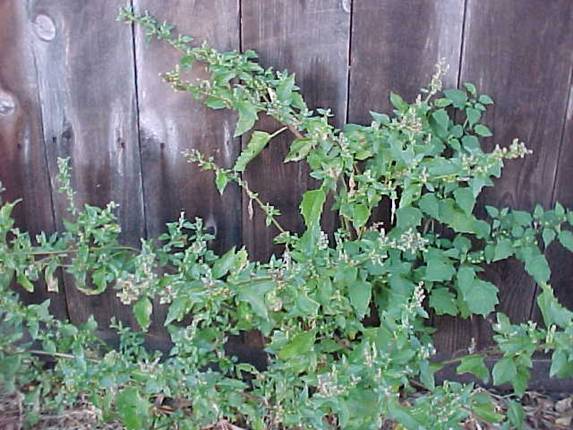
This is an extremely variable annual. It typically grows upright (up to
6 feet), although some plants grow wider. The stems are many branched and often
striped with pink or purple. Plants
often form large clusters which could be a single plant that is highly branched
at the base, or multiple plants from individually germinated seeds.
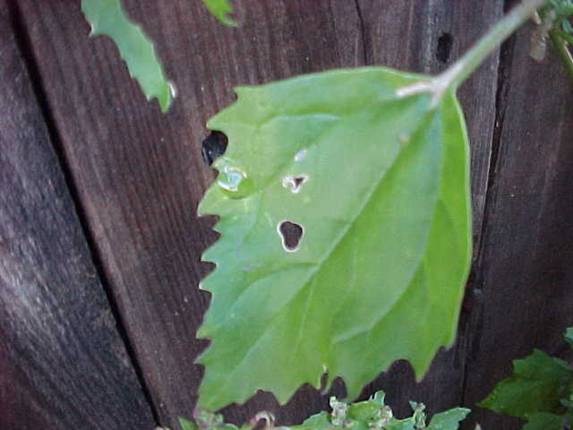
The light green leaves are alternate with upper leaves
margins wavy to somewhat lobed while the lower leaves are narrow often with
entire margins.
The flowers
occur in dense terminal and axillary spikes. Flowers are green and lack petals

This plant is sometimes called Pigweed but needs to be differentiated from
Common Pigweed (Amaranthus retroflexus).
Chenopodium has approximately 60 species, one-third found in America. The
native American lamb’s quarter, C. berlandieri, is indistinguishable from C. album apart from
subtleties of the seed coat. The former is more prevalent in the central and
western states, and the latter in eastern.
Lamb's quarter is native to Eurasia, but now naturalized throughout North
America. Lambs quarter variants range from coast to coast, from Canada to
Mexico, and are found throughout Europe.
Goosefoot is an erect, annual herb varying much in size from 30 cm to 2 meters
in height. The stems are erect, smooth, longitudinally grooved, and often red,
purple or light-green striped. Chenopodium comes from the Latin for "goose
foot", which describes the shape of the leaves. The leaves are 2.5-8 cm
long, stalked, smooth, and covered with tiny white mealy particles/scales,
particularly on the lower surface. Occasionally the plant may have purple- to
wine-colored leaf bases. The entire plant is covered with varying amounts of a
waxy substance giving the plant a light green appearance.
The flowers are inconspicuous, green, without petals, and are found in dense
clusters at the tips of branches and at the top of the stem. Goosefoot flowers
throughout the summer and predominantly in the autumn, producing abundant
amounts of pollen. A full-grown plant can give off as many as 20 000 pollen
grains. The flowers are hermaphrodite (have both male and female organs) and
are pollinated by wind. The tiny seeds are disc shaped with a notch. They are
glossy black, brown or brownish green, and 1.2-1.6 mm in diameter, and ripen
from August to October. Lamb’s quarter is an important aeroallergen in
mid-Europe, where 24 to 27% of hay fever sufferers are skin test positive to
it. (Horak 1979 ref.7686 3)
Goosefoot is found in open habitats, rubbish tips and on cultivated fields, and
especially on rich soils, old manure heaps, in overgrazed lands, brush burns
and logged openings, desert grasslands, and juniper-pine forests. It does not
grow in the shade. Chenopodium species are tolerant of salty soils; thus, they
play a role in the coastal flora around the Mediterranean, the Red and Caspian
Seas, the central steppes of Asia, the edge of the Sahara, the pampas of
Argentina, the South African Karoo, the Mulga of Australia and the alkaline
plains of the southwest USA.
It was very much a prehistoric and medieval food and medicinal plant. It is
related to the spinach family and is vitamin-rich. The leaves and seeds of all
members of this genus are more or less edible. They can be cooked and eaten as
a spinach substitute or dried. The seed can be dried and ground into a meal,
eaten raw, baked into a bread as used by American Indians, or added as a
supplement to grain flour. The ground seeds can also be used as medication such
as an antidote against worms.
However, many of the species in this genus contain saponins, though usually in
quantities too small to do any harm. The plants also contain some oxalic acid.
In nitrogen-rich soils, the plants can also concentrate hydrogen cyanide.
Characteristics Important in Control. Rapid
growth and heavy water intake create problems in planted areas. Lambsquarters
also serves as an alternate host of the beet leafhopper. In turf mowing tend to
reduce problems.