Ivyleaf Morningglory-Morningglory Family
Ipomoea nil
Characteristics. There are two species of morningglory
(tall and ivyleaf) that are native to tropical
Identifying Characteristics. Ivyleaf morningglory has a well-developed
taproot and leaves that vary from heart shaped or more commonly 3 to 5
lobed. Tall morning glory has a fibrous
root system and heart shaped leaves.
The 1 to 2 inch diameter flowers of both
species range in color from white to purple.
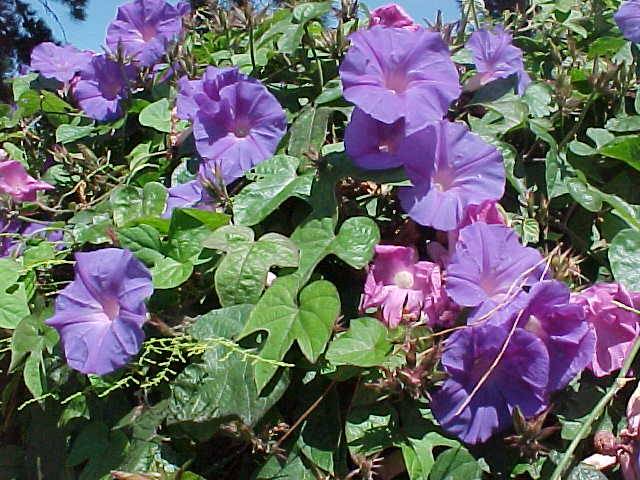
Most morning glory flowers curl up and
close during the warm parts of the day, and are fully open in the morning, thus
their name. On a cloudy day, the flower may last until night. The flowers
usually start to fade a couple of hours before the petals start showing visible
curling. They prefer full sun throughout the day and mesic soils.
Some morning glories, such as Ipomoea muricata, are night blooming
flowers.
In some places such as Australian bushland,
some species of morning glories (bindweed)
develop thick roots and tend to grow in dense thickets. They can quickly spread
by way of long creeping stems. By crowding out, blanketing and smothering other
plants, morning glory has turned into a serious invasive weed problem.
In cultivation, most are treated
as perennial plants in frost-free areas and
as annual plants in
colder climates, but some species tolerate winter cold. There are some species
which are strictly annual (eg. I. nil), producing
many seeds, and some perennial species (eg. I. indica) which are propagated
by cuttings. Some moonflowers, which flower at night, are also in the morning
glory family.
Because of their fast growth, twining
habit, attractive flowers, and tolerance for poor, dry soils, some morning
glories are excellent vines for creating summer shade on building
walls when trellised, thus keeping the building cooler and reducing heating and
cooling costs.
Popular varieties in contemporary
western cultivation include 'Sunspots', 'Heavenly
Blue', the moonflower, the cypress vine,
and the cardinal climber. The
cypress vine is a hybrid, with the cardinal climber as one parent.
Morning glory was first known in China for its medicinal uses, due to the laxative properties of its seeds.
It was introduced to the Japanese in the 9th
century, and they were first to cultivate it as an ornament. A rare
brownish-colored variant known as Danjuro is very popular. During the Edo Period, it became a
very popular ornamental flower.
Ancient Mesoamerican civilizations
used the morning glory species Ipomoea alba to convert the latexfrom
the Castilla
elastica tree and also the guayule plant to
produce bouncing rubber
balls. The sulfur in the morning glory's juice served to vulcanize the rubber, a process pre-dating Charles Goodyear's discovery by at least 3,000
years. Aztec priests in Mexico were also known to use the plant's hallucinogenic
properties.
The morning glory represents "love
in vain" for whatever outside circumstances according to the Victorian
"Language of Flowers", which attributed various properties and
sentiments to flowers so that people could communicate their feelings by what
flowers were given as gifts, such as those by a suitor to their loved
one."(What's the Story) Morning Glory?" is the title of British rock
band Oasis's second album, released in October
1995.The line "What's the story, morning glory?" is the opening to
"The Telephone Hour" from the musical Bye Bye
Birdie.Wake Up Honey, a song from the 2008 album Azn Pride -This Iz the Japanese Kabuki Rock- by Miyavi,
whose chorus uses the flower metaphorically in reference to the way the flower
blooms early in the morning; is an early riser.
Ipomoea
aquatica, known as water spinach, water morning-glory, water
convolvulus, Ong-Choy, Kang-kung, or swamp cabbage, is popularly used as a
green vegetable especially in East and Southeast Asian cuisines. In the
The seeds of many species of morning glory contain ergot alkaloids such as the hallucinogenic ergonovine and ergine (LSA). Seeds of