Buffalobur-Nightshade Family
Beaked nightshade,
Solanum rostratum
Charactristics. This native
to the Great Plains now occurs commonly from the
Identifying Characteristics. Buffalobur
is a low growing, yellow-flowered, spined, hairy annual. The
stems (mostly branching in the upper part), are erect and bushy, 1/2 to two
feet long. The entire plant, except the for the flower petals, is
covered by straight yellow spines, 1/8 to 1/2 inch long. The leaves are
alternate and two to six inches long including the stalks. Each leaf is
irregularly cut into five to seven lobes, and often these are two to five
lobed. The leaves are covered by short yellow star-like hairs, and the midribs,
veins, and leaf stalks are spiny. The yellow flowers are five-lobed,
wheel-shaped, 1 to 1.5 inches across, in few flowered clusters on spiny flower
stalks. The calyx is covered by spines; it enlarges and forms a spiny bur,
enclosing and completely covering the seedpod. The seeds are almost circular,
1/2 inch or slightly more in diameter, brown to reddish brown, flattened, irregularly
angled, with a finely pitted surface. To identify buffalobur, look for the
tomato-like yellow flowers and the unique, extremely prickly leaves, stems and
fruits.
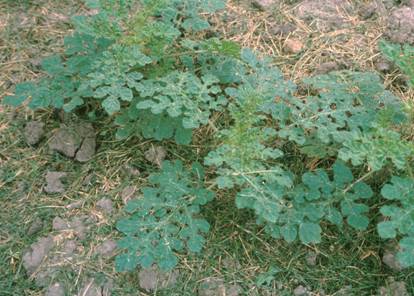
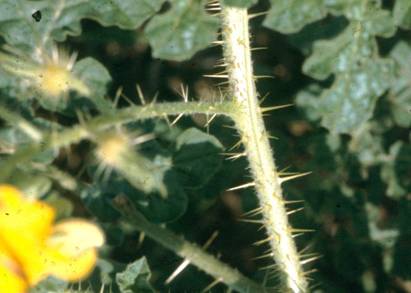
Images courtesy of Dr. Fred Fishel,
The relatively large 5 lobed yellow flowers
develop early in the summers and typically remain until fall.
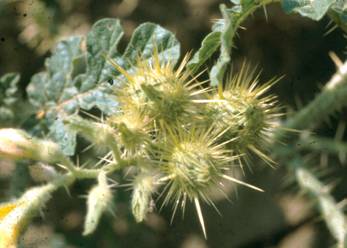
Image courtesy of Dr. Fred Fishel,
Economic
Importance: Buffalobur is considered to be a "nuisance weed" of
barnyards, corrals, etc. The burs may cause damage and considerable loss in
wool value in sheep. Buffalobur is considered noxious on farms and rangelands.
Geographical
Distribution: Buffalobur is native to the
Habitat: Buffalobur grows in fields, overgrazed
pastures, yards, roadsides, waste areas, and barn
yards. Although it is adapted to sandy soils, it will also grow on dry hard
soils to rich moist soils of cultivated fields.
History: Buffalobur is a native North American
species; its range extending from central
Growth and Development: Buffalobur is an annual
species. The plants bloom in late June to early August and the seeds mature
from July to Octobe. It reproduces by
seeds only.
Response to Herbicides: 2,4-D
plus Banvel can control buffalobur: Buffalobur is moderately susceptible to
2,4-D when seedlings are immature. It becomes very resistant to 2,4-D after flowering. A combination of 2,4-D
plus Banvel usually provides more complete control than either herbicide alone.
Apply 2 quarts 2,4-D (3.8 pound acid equivalent per
gallon) plus 1 pint Banvel per acre before plants bloom. Always follow label
instructions.
Although buffalobur can be found in some row crops as
a weed, it is not considered to be a highly competitive in a row crop
situation. However, it is considered a
nuisance in waist areas, rangeland, pastures, and yards. Although buffalobur leaves and immature fruit
are considered toxic, the spines generally make the plant unpalatable. It should be controlled in a pasture
situation to make sure that the plant does not find its way into
hay. Buffalobur is ranked as a noxious
weed in several states. It is not
considered one of